


About Charlottenlund Palace
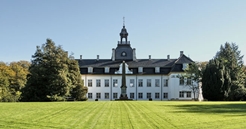
Charlottenlund Palace and Palace Gardens
Charlottenlund Palace was a royal residence for many years. Through some 200 years, ca 1730-1930, the successive royal residents left their imprint on the palace.
In the 1880s Charlottenlund Palace Gardens were transformed from the Baroque to the Romantic style. The Anglo-inspired gardens are home to a multitude of small, stylish attractions.
Charlottenlund Palace was built for and named after Christian VI's sister Charlotte Amalie in 1731-33. It was probably designed by the architect Johan Cornelius Krieger under the supervision of the engineer officer H.H. Scheel and was not so much a new palace, as a refurbishment and expansion of an older country seat called Gyldenlund.
For many years during the 19th century Princess Louise Charlotte and landgrave Vilhelm of Hessen occupied the palace, until Crown Prince Frederik VIII and his wife Louise took it over in 1869. They had the architect Ferdinand Meldahl radically alter the palace in 1880-81: two bay windows, two transverse wings and a dome with lanterns were all added. The Baroque palace completely changed character, re-emerging in French Renaissance style. In 1883, Meldahl also added cavalier's quarters and a chancellery along Jægersborg Allé 1.
Both Christian X and his brother prince Carl, who was named King Håkon of Norway in 1905, were born at Charlottenlund Palace and the Queen Mother Louise lived there until she died in 1926. The royal family stopped using the castle in 1935 when it was refurbished for the benefit of the Danish Institute of Fisheries and Ocean Research which moved in the following year.
Photos of Charlottenlund Palace
Seen Charlottenlund Palace?
This place is waiting to be seen by others! Got a photo?
Log in and add it — it takes a second or two.
What travellers say
Been to Charlottenlund Palace?
Rate it on 5 points and tell travellers what you thought.
Log in to review →